Nepal Chapter of the Lancet Commission on Investing in Health 3.0
Background
Nepal has made significant progress in improving population health, with increased life expectancy and reduced maternal and child mortality. However, the country faces a shifting burden of disease towards non communicable diseases and injuries, alongside persistent gaps in financial risk protection. Despite some progress in Universal Health Coverage (UHC), limited public investment- Only 1.7% of GDP- and low health insurance coverage, particularly among the poorest, have contributed to rising out-of-pocket spending and increasing rates of catastrophic health expenditure. With the Probability of Premature Mortality/ Death (PPD) still above global averages, a robust health financing assessment is essential to inform strategies that strengthen financial risk protection and address the evolving burden of disease with equitable outcomes. Following the launch of the Global Health 2050 report by the Lancet commission on investing in health 3.0 (CIH) the national chapter of CIH, under the aegis of the global CIH, will be launched in Nepal and will work in generating a recommendation for a balanced path of achieving health gain and improving financial risk protection, with a focus on harmonizing the fragmented and potentially inefficient health financing schemes. The theme of Nepal CIH will be “Spending wisely in Health: Redesigning the Health Financing architecture of Nepal”.
Goals
With the purpose of supporting Nepal’s policy direction towards a balanced path of improving health status and financial risk protection, the Nepal CIH aims to analyze the “allocative efficiency of resources” and “technical efficiency of healthcare delivery system”. This core analysis will be complemented by a contextual analysis of the population health status, alongside targeted analysis of interrelated domains as outlined in the specific objectives below. The findings will inform actionable policy recommendations and guide the strategic redesign of Nepal’s health financing architecture, with the objective of enhancing equity, efficiency, and sustainability in Nepal’s path to Universal Health Coverage (UHC).
Approach
The overall approach will include a comprehensive, evidence-based approach to health financing reform, involving expert input, rigorous analysis, and stakeholder engagement. The task will be led by a core technical team comprised of experts from Nepal and representative expert from the Global CIH. This will be further supported by a technical advisory team and a policy advisory team. In addition, there will be a network of commissioners representing both national and international stakeholders with relevant expertise and experience to contribute to the task in Nepal, as detailed below. Additional experts and stakeholders can be invited as a part of network of commissioners as and when required.
Priority Setting for Universal Health Coverage (UHC) in Nepal
Background
Nepal Health Economics with technical support from The Bergen Centre for Ethics and Priority Setting in Health (BCEPS), Department of Global Public Health and Primary Care, University of Bergen (UiB) has been supporting Ministry of Health and Population in prioritizing health sector interventions for Universal Health Coverage (UHC) in Nepal. Project is funded by Norwegian Agency for Development Cooperation (NORAD). As a local academic partner, NHEA has also been collaboration with Kathmandu university to develop in-country capacity on health economics and scientific priority setting process,
Goals
The overall goal of the project is to improve efficiency, equity and financial risk protection while maximizing health outcomes among people of Nepal in the path towards UHC by supporting one of the strategies of the National Health Financing Strategy (2023-2033). Specifically, this project will review the current health system interventions including all three disease components, non-communicable diseases and injuries (NCDIs); communicable diseases; and reproductive, maternal, neonatal, child and adolescent health and nutrition (RMNCAH-N) related conditions and carry out prioritization of health system/program interventions to propose an updated essential healthcare package (EHCP) in Nepal.
Approach
This task will use a stepwise approach to priority setting using a framework contextualized for Nepal. Baseline evidence on epidemiology and service coverage will be collected from the available sources and literature; target coverage of the interventions and the population outcomes that the country wants to achieve will be agreed in consensus with the relevant stakeholders in coordination of respective program divisions and sections under the MoHP and Department of Health Services (DoHS). Data on cost effectiveness of interventions where available from local context, else from similar context will also be collated. Analysis will be done using FairChoices DCP analytics tool and using expertise from BCEPS to come up with the priority interventions as well as detail of financing information. This will be taken through a systematic process of prioritization using an agreed set of criteria in addition to the analysis and the quantitative results that arrive from the analysis.
Latest Initiatives
Discover our recent initiatives shaping the landscape of health economics in Nepal

Panel discussion on the Tobacco Symposium pre-budget 2080/81
Panel discussion on occasion of World Health Day, jointly organized by NHEA and AMN.
Interaction program with the slogan 'Build the World We Want; A Healthy Future for All'
On the occasion of Universal Health Coverage Day, jointly organized by MOHP, NHEA, and HIB.
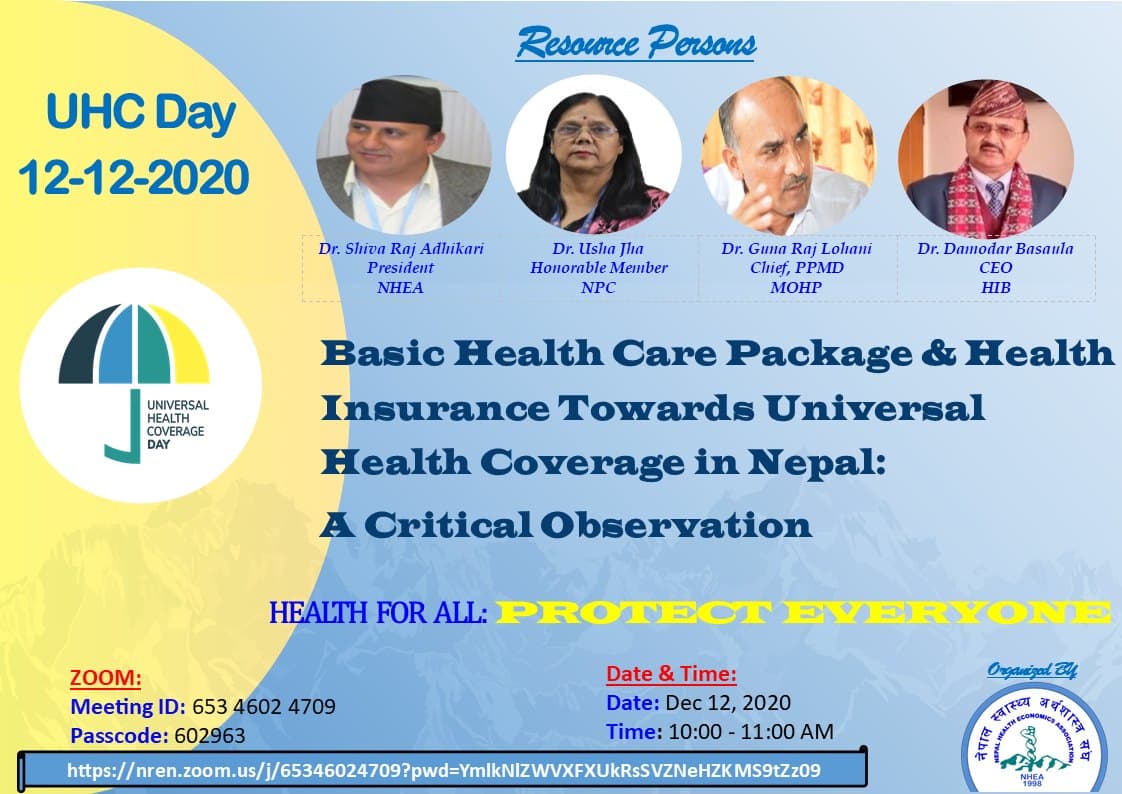
Basic Health Care Package & Health Insurance Towards Universal Health Coverage in Nepal: A Critical Observation
Online interaction program on the occasion of Universal Health Coverage Day organized by NHEA.
COVID-19 Economic Impact on Health Systems
Webinar series analyzing the economic implications of COVID-19 on Nepals health system and recovery strategies.
Health Economics Training for Healthcare Professionals
Capacity building program focusing on economic evaluation methods in healthcare decision-making.
Policy Dialogue on Universal Health Coverage
Multi-stakeholder dialogue on financing mechanisms for achieving UHC in Nepal.
Join our future initiatives and contribute to advancing health economics
Universal Health Coverage Day 2025
Annual event examining progress and challenges towards UHC in Nepal, following the tradition of previous years.
Health Economics Training Program
Comprehensive 5-day training program for healthcare professionals and researchers on economic evaluation methods.
Regional Conference on Health Economics in South Asia
International conference featuring speakers and research presentations on health economics.
Active Initiatives
Our sustained efforts creating lasting impact in health economics
PhD in Health Economics
PhD program in collaboration with University of Bergen, Norway, to strengthen health economics capacity for Universal Health Coverage in Nepal, funded by NORAD.
Political Economy of Health Tax Reform in Nepal
Ongoing study supported by WHO Alliance for Health Policy and Systems Research.
Health Economics Research Network
Building a network of researchers across Nepal to collaborate on health economics studies.
Capacity Building Initiative
Training healthcare professionals in economic evaluation methods and health policy analysis.
Policy Advisory Services
Providing technical assistance to government agencies on health financing and policy matters.